Introduction
Carriage house garage doors blend old-world charm with modern convenience, making them a popular choice for homeowners who want a distinctive exterior without giving up today’s overhead operation. In this guide to carriage house garage doors, you’ll learn what defines the style, why it looks so different from standard panels, and what that difference can mean for your budget and your weekend to-do list. We’ll walk through typical cost considerations, compare carriage house vs traditional garage door options, and clarify insulation and efficiency questions. You’ll also get a realistic view of maintenance, from finish care to hardware checks, so you can decide whether the look and customization are worth the ongoing upkeep.
- Carriage house style mimics swing-out barn doors but usually operates like a modern overhead door
- Costs vary widely based on materials, insulation, windows, and decorative hardware
- The main benefits are curb appeal and design flexibility, not necessarily lower maintenance
- Upfront price can be higher than many traditional styles, especially with premium finishes
- Insulation is often available, but performance depends on construction and sealing details
Overview of Carriage House Garage Doors
Carriage house garage doors are defined more by appearance than by a single construction method. The style typically features vertical boards or paneling, decorative handles, strap hinges, and window grilles that suggest a historic carriage house. Most modern versions are sectional overhead doors designed to fit standard tracks, so you can get the classic look without needing clearance for true swing-out operation.
Because the design is so visual, small choices matter. Window shape, overlay patterns, and hardware placement can change the feel from rustic to refined. Before you shop, it helps to know which elements are purely decorative and which affect performance, such as the door’s material, thickness, and sealing system.
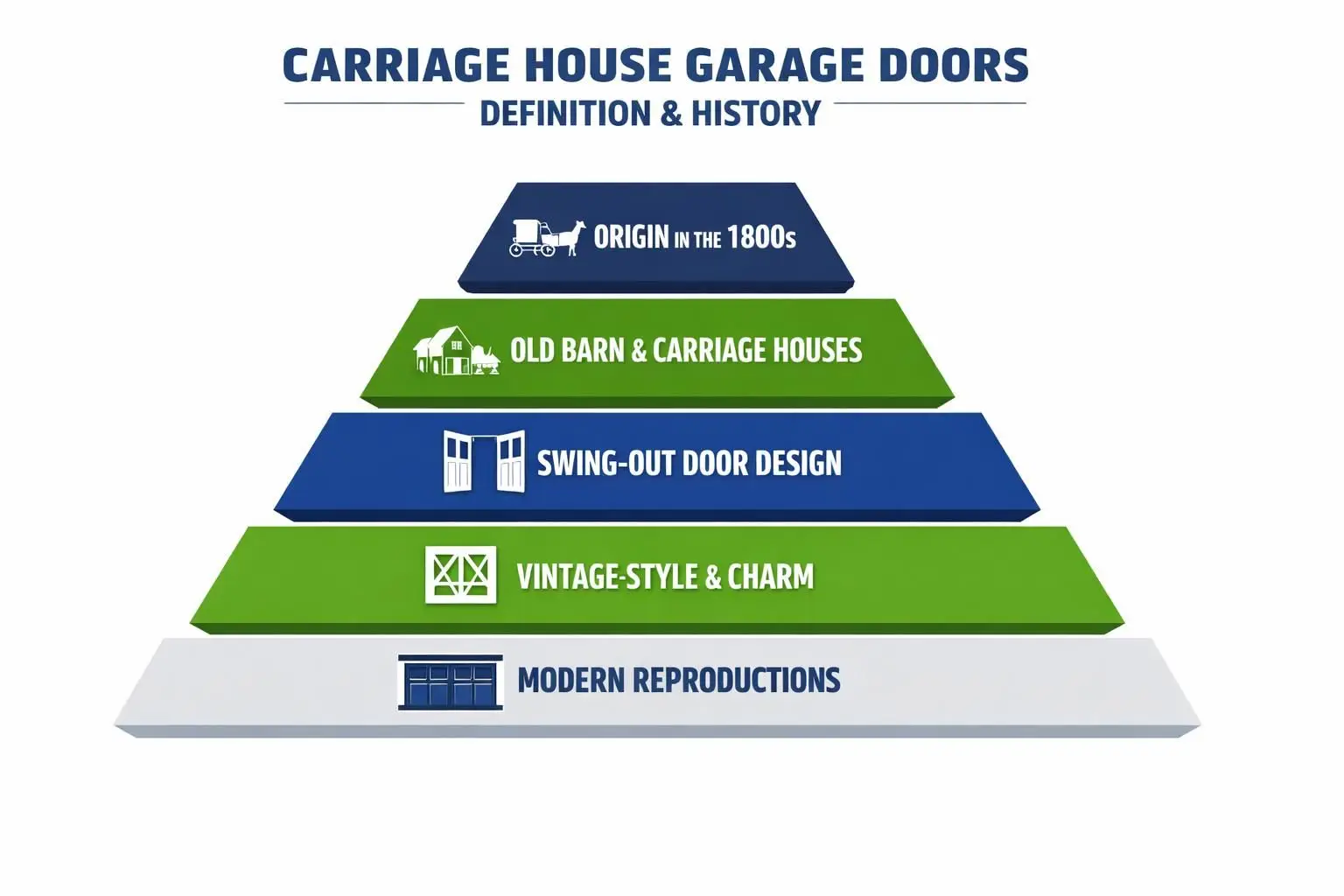
Definition and History
Historically, carriage house doors were large swing-out doors used to store carriages and horses. They were built as paired leaves that opened outward, often made from wood planks and reinforced with iron hardware. The look became associated with craftsmanship and traditional architecture, especially on homes that lean farmhouse, craftsman, cottage, or colonial.
Modern carriage house designs borrow those cues while using contemporary engineering. Many are sectional doors with surface overlays that mimic rails and stiles. Some homeowners still choose true swing-out versions, but these require driveway clearance and a different hardware setup. Understanding the origin helps you spot authentic proportions, such as taller windows near the top and a more vertical visual rhythm than many raised-panel designs.
Carriage house garage doors are defined more by appearance than by a single construction method. The style typically features vertical boards or paneling, decorative handles, strap hinges, and window grilles that suggest a historic carriage house. Most modern versions are sectional overhead doors designed to fit standard tracks, so you can get the classic look with a garage door consultation without needing clearance for true swing-out operation.
Design Aesthetics
The biggest draw is the curated, architectural appearance. Carriage styling can soften a wide garage opening by adding detail, symmetry, and texture, especially when the rest of the facade has natural materials like stone, brick, or wood accents. Windows are often a key feature, bringing light into the garage and tying into nearby window muntins on the home.
You can steer the aesthetic in multiple directions:
- Rustic: wood tones, larger strap hinges, arched windows
- Classic: symmetrical window rows, restrained hardware, clean overlays
- Modern farmhouse: simple crossbuck patterns, matte hardware, clear glass
The goal is to coordinate with your home’s trim color, roofline, and entry door style so the garage looks intentional rather than themed.
Costs of Carriage House Garage Doors
Pricing is where many homeowners pause. Carriage styling can be achieved with different materials and constructions, and each choice shifts both initial cost and long-term ownership. Decorative overlays and hardware can also add to complexity, especially when paired with custom paint or stain.
It’s also important to separate the cost of the door itself from the broader project. Items like track upgrades, opener compatibility, new seals, or reframing a rough opening can change the total. When comparing options, ask for a clearly itemized quote so you can see what you are actually paying for.
Average Price Range
Carriage house garage door cost typically spans a broad range because the category includes everything from steel doors with stamped carriage patterns to custom wood doors with premium glazing. In general terms, simpler steel or composite models tend to be more budget-friendly, while real wood and highly customized builds sit at the higher end.
Your final number is influenced by door size, insulation level, window package, and finish requirements. If you’re aiming for a specific stain grade or want a unique window layout, expect more design and labor complexity. To avoid surprises, confirm what finish is included and whether the door arrives ready to install or needs on-site staining or painting.
Factors Influencing Cost
Several variables commonly move the price up or down. Material is often the biggest lever, with steel, composite, and wood each offering different tradeoffs in weight, durability, and refinish needs. Insulation level matters too, especially when paired with thicker sections and better edge seals.
Other common cost drivers include:
- Door size and configuration (single vs double)
- Window count, glass type, and grille style
- Decorative hardware kits and handle sets
- Custom color matching, stain finishes, or faux-wood coatings
- Wind-load or reinforcement needs based on local conditions
Weight also plays a role, since heavier doors may require stronger springs and more precise setup.
Carriage House Garage Door Cost vs. Traditional Options
When comparing carriage house vs traditional garage door designs, the difference often comes down to how much visual detail you’re buying. A basic raised-panel steel door can be relatively simple to manufacture and finish. Carriage house styling may add overlays, extra panel definition, windows, and hardware that increase materials and labor.
That said, a traditional door can become similarly priced if you add insulation, upgraded windows, or premium finishes. The best comparison is between doors with similar construction quality. If two doors have the same insulation level and build quality, the carriage look may still cost more due to design elements, but the gap can narrow depending on the model and finish.
Advantages of Carriage House Garage Doors
The benefits of carriage styling are most obvious from the street. The garage door can occupy a large portion of your home’s front elevation, so upgrading its design can change the entire first impression. Carriage designs also provide a structured way to add texture and contrast without remodeling the facade.
Beyond appearance, many carriage-style doors are offered across multiple materials and insulation levels. That means you can often match your climate and usage needs, such as a garage that doubles as a workspace, without giving up the look you want.
Unique Appeal
Carriage house garage doors stand out because they add character rather than just coverage. The combination of vertical lines, hardware, and windows can make the garage feel more like an extension of the home’s architecture. This is especially helpful on wide, front-facing garages where a flat panel design can look oversized or plain.
The style also works across many home types. With the right window shape and finish, it can read as historic, coastal, rustic, or transitional. If you want a door that looks custom even when built from standard sections, carriage styling is one of the most reliable ways to get there.
Increased Property Value
A well-chosen garage door can support perceived home quality, which matters to buyers and appraisers as part of overall curb appeal. Carriage styling often signals premium design intent because it resembles handcrafted doors and includes details like grilles and hardware.
The key is matching the door to the home. A carriage look that complements trim lines, colors, and window patterns is more likely to feel like a true upgrade. If you plan to sell within a few years, focus on timeless choices: neutral finishes, classic window layouts, and hardware that looks proportional rather than oversized.
Carriage house garage door cost typically spans a broad range because the category includes everything from steel doors with stamped carriage patterns to custom wood doors with premium glazing. In general terms, simpler steel or composite models tend to be more budget-friendly, while real wood and highly customized builds sit at the higher end, as discussed in the comparison of steel vs wood vs aluminum garage doors.
Versatility in Design
Carriage doors offer a lot of customization without requiring a fully custom build. You can change the entire vibe by swapping window shapes, grille patterns, overlay designs, and color. Many homeowners also use contrast, such as a darker door with lighter trim, to frame the opening and create depth.
Functionally, you can often choose:
- Material (steel, composite, wood)
- Insulation level and interior backing
- Window placement for privacy and daylight
This flexibility makes it easier to balance aesthetics with practical needs like durability, maintenance, and energy performance.
Disadvantages of Carriage House Garage Doors

The same design features that make carriage doors attractive can add complexity. More trim, more hardware, and more finish surfaces can mean more to maintain. Some materials are also heavier, which can increase wear on springs and rollers if the system is not properly matched and adjusted.
It’s also easy to overbuy. If your garage isn’t visible from the street or you don’t care about decorative details, you may not get much value from the premium look. The best approach is to decide whether the style solves a specific curb-appeal problem or simply adds a design you love enough to maintain.
Higher Upfront Costs
Many carriage designs cost more upfront than plain options, especially when wood, thicker construction, or upgraded window packages are involved. Even when the base door is affordable, add-ons like decorative hardware, custom finishes, and higher insulation can push the total higher than expected.
Heavier doors can also require upgraded components. Stronger springs, reinforced tracks, and careful balancing are important for smooth operation and opener longevity. If you’re budgeting, prioritize construction quality first, then allocate remaining funds to windows and decorative features that deliver the biggest visual payoff.
Maintenance Requirements
Maintenance depends heavily on material and finish. Wood doors can require periodic sealing or repainting to prevent moisture damage, warping, or fading. Steel doors are typically easier, but dents, scratches, or chipped paint should be touched up to prevent corrosion where the coating is compromised.
Even if the door surface is low-maintenance, the hardware look can introduce extra care. Decorative handles and hinges can loosen over time or collect grime. Windows may need more frequent cleaning, especially if they have grilles or textured glass that traps dust.
Carriage House Garage Door Upkeep
Carriage house garage door upkeep is usually straightforward but should be consistent. A simple routine reduces noise, extends hardware life, and helps the door keep its premium look. Focus on both appearance and operation, since carriage styling often draws attention to details.
A practical upkeep checklist includes:
- Clean door surface with mild soap and water; avoid harsh abrasives
- Inspect weatherstripping for cracks and replace if it no longer seals
- Tighten visible fasteners on hinges and brackets as needed
- Lubricate rollers, hinges, and springs with a garage-door-appropriate lubricant
- Check balance and travel; a door that feels heavy or slams should be serviced
If you have a wood finish, monitor sun-facing areas for fading or peeling and refinish before moisture gets in.
Insulation and Energy Efficiency
Insulation matters most when the garage is attached to the home, when there are rooms above or beside it, or when you use the space frequently. A well-insulated door can help stabilize temperatures and reduce drafts, but it’s only one part of the equation. Seals, door fit, and even the garage walls and ceiling influence overall comfort.
Carriage styling does not automatically mean better or worse efficiency. The key is the underlying construction: insulated core, section thickness, thermal breaks, and the quality of perimeter sealing. Window choices also affect performance, since glass typically insulates less than an insulated panel.
Are Carriage House Garage Doors Insulated?
Are carriage house garage doors insulated? Many models can be ordered with insulation, but availability and performance vary by manufacturer and material. Some doors use an insulated core with a steel or composite exterior, while others rely on an added interior insulation layer. Wood doors may be built as thicker assemblies, but that does not always equal high insulation without a designed core and good sealing.
If energy efficiency is important, look for an insulated construction option and ask how the insulation is integrated. Also confirm whether the door includes upgraded bottom seal and side/top weatherstripping, because air leakage can undermine the benefit of insulation.
If energy efficiency is important, look for an insulated construction option and ask how the garage door insulation is integrated. Also confirm whether the door includes upgraded bottom seal and side/top weatherstripping, because air leakage can undermine the benefit of insulation.
Carriage house garage doors stand out because they add character rather than just coverage. The combination of vertical lines, hardware, and windows can make the garage feel more like an extension of the home’s architecture. This is especially helpful on wide, front-facing garages where regular garage door maintenance can prevent a flat panel design from looking oversized or plain.
Benefits of Insulation
Insulation can make the garage more comfortable and the door quieter. A more rigid, insulated door often vibrates less, which can reduce rattles and improve the feel of operation. It can also help protect items stored in the garage from rapid temperature swings, especially near the door opening.
Additional benefits often include:
- Reduced drafts when paired with good perimeter seals
- Better sound buffering between the street and interior spaces
- Improved durability from added panel stiffness
To maximize results, pair an insulated door with attention to the rest of the garage envelope, including gaps, thresholds, and any shared walls with living space.
Conclusion
Carriage house garage doors are a style-forward upgrade that can dramatically improve curb appeal, especially on front-facing garages where the door dominates the facade. The tradeoff is that the added design detail often raises the initial budget and can increase ongoing care, particularly if you choose wood or complex window and hardware packages. If comfort matters, verify insulation options and sealing quality rather than assuming the look tells you anything about performance. As a practical next step, list your must-haves (material, windows, insulation, finish) and request itemized quotes so you can compare value, not just style, before committing to carriage house garage doors.