If your garage door gets stuck halfway in Renton, don’t shove, pull, or keep running the opener. The cause may be as simple as a sensor issue, but it can also involve a spring, cable, track, roller, or opener problem. Some of those parts carry heavy tension and can be dangerous to force.
This guide explains what you can safely check, what common symptoms usually mean, and when to stop using the door. Best first step: observe from a safe distance, check sensors, and note sounds. Call a pro if the door is crooked, heavy, noisy, hanging by cables, stuck open, or trapping your vehicle inside.
Quick Summary
- Stop using the opener if the door stops halfway more than once.
- Sensor and opener issues can look similar to hardware problems.
- Crooked, heavy, or cable-hung doors are safety concerns.
- Safe checks include looking, listening, and clearing obvious obstructions.
- Technician details help speed up diagnosis and repair planning.
- Dan’s Garage Door Services can help with stuck doors in Renton.
Do Not Force a Door That Stops Halfway
A garage door that stops halfway should not be forced, lifted, pulled down, or repeatedly run with the opener. It may be blocked, binding against the track, or hanging unevenly from a cable.
Think of the door as a large moving wall. The opener is only one part of the system. Springs help carry the weight, cables guide the lift, tracks keep the door aligned, and rollers move inside the tracks. If one part fails, forcing the door can make the damage worse.
Stop immediately if you notice any of these signs.
- The door looks crooked or tilted.
- The opener hums, but the door barely moves.
- The door feels unusually heavy.
- A cable is loose, frayed, or hanging.
- The door bangs, pops, grinds, or scrapes.
- The door is stuck open and won’t come down evenly.
If a car is trapped inside, keep people and pets away from the door area. Then call for garage door opener warning signs if the opener is straining or behaving oddly.
Opener Issue vs Door Hardware Issue
An opener issue usually affects the motor, controls, sensors, or settings. A hardware issue affects the physical door parts that carry and guide the door. That distinction matters because opener problems are often safer to observe, while hardware problems can involve tension-loaded parts.
The opener is the motorized unit that moves the door using a rail and drive system. The hardware includes springs, cables, tracks, rollers, hinges, and brackets. If the opener tries to move the door and the door resists, the opener may stop as a safety response.
| Symptom | More likely opener-related | More likely hardware-related | Stop using it when |
|---|---|---|---|
| Door starts to close, reverses, then stops halfway | Sensors or travel setting | Binding track or roller | It repeats after clearing the opening |
| Door opens a few feet, then opener hums | Motor or drive issue | Weak spring or heavy door | The opener strains or smells hot |
| Door is stuck open and crooked | Less likely | Cable, roller, or track issue | One side sits lower than the other |
| Wall button clicks, but door doesn’t move | Control or opener issue | Jammed door | You hear grinding or popping |
For example, if the door starts to close, reverses, and stops halfway, the sensor area may be blocked. Safety sensors sit near the bottom of the tracks and detect objects in the door’s path. If they don’t line up, the opener may refuse to close.
But if the door opens a few feet and stops while the opener hums or strains, the door may be too heavy for the opener to move. That can happen when a spring is weak or broken, a roller is jammed, or the track is damaged. If you’re not sure whether the opener or door is at fault, Dan’s Garage Door Services can inspect both as part of opener installation and repair in Renton.
Track, Spring, Cable, and Roller Problems
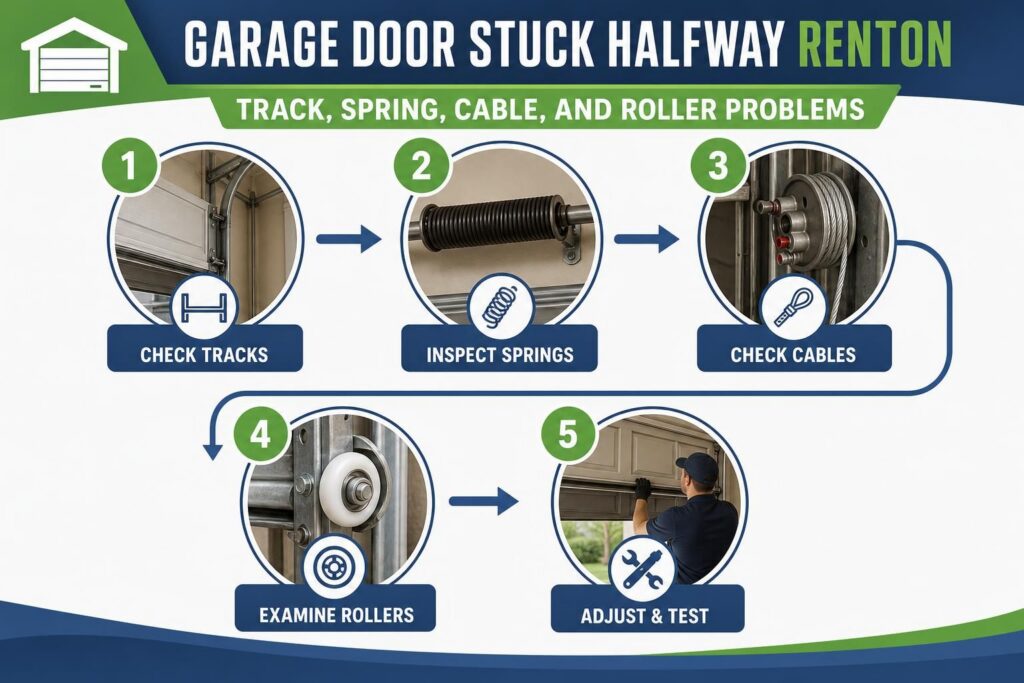
Track, spring, cable, and roller problems are serious because they affect how the door’s weight is supported and guided. Do not loosen, bend, reset, or adjust these parts yourself.
Tracks are the metal rails on both sides of the door. If a track is bent or blocked, the rollers may bind. This can happen after a vehicle bump, a shifted storage item, or debris near the opening. If the door moved after a bump and now stops in the same spot, that is a useful clue.
Springs are tightly wound parts that help lift the door. A broken or weak spring can make the door feel extremely heavy. Don’t touch it, remove brackets, or try to “help” the opener by lifting the door. Spring work belongs to trained technicians because stored tension can release suddenly.
Cables run along the sides of the door and help lift it evenly. A slipped or frayed cable can make one side lower than the other. If your door is stuck open or halfway and appears crooked, stop. For background on why this is risky, read about a snapped garage door cable before attempting anything around the door.
Rollers can also wear out or jump out of position. Nylon and steel rollers can both cause scraping, shaking, or rough travel when damaged.
Safe Checks Before Calling
The safest homeowner checks are visual and simple: look for obvious problems, listen to the opener, and avoid touching springs, cables, tracks, rollers, or wiring. Your goal is to gather clear information, not repair the door.
Use this sequence only if you can stand clear and the door isn’t hanging crooked, loose, or unstable.
- Stop pressing the remote or wall button. Repeated attempts can strain the opener and shift a damaged door farther out of place.
- Move people, pets, and vehicles away from the door. Treat the opening as a safety zone, especially if the door is stuck open or halfway.
- Look for an obvious obstruction. Check for boxes, tools, ice, leaves, rocks, or trash near the bottom of the door and tracks. Don’t reach into pinch points.
- Check the sensor lights. Look near the floor on both sides of the door. If one sensor light is off or blinking, the sensors may be blocked or misaligned. If this seems likely, reset garage door safety sensors may help you understand the basic issue.
- Press the wall control once and listen. Does the opener click, hum, grind, or strain? Does the door move evenly? Stop after one test.
- Visually inspect the door from a safe distance.
Look for a crooked bottom edge, loose cable, bent track, or roller that seems out of line.
If anything looks unstable, don’t disconnect the opener. Pulling the emergency release on a heavy or broken door can let the door drop or move unexpectedly.
Information to Give the Technician
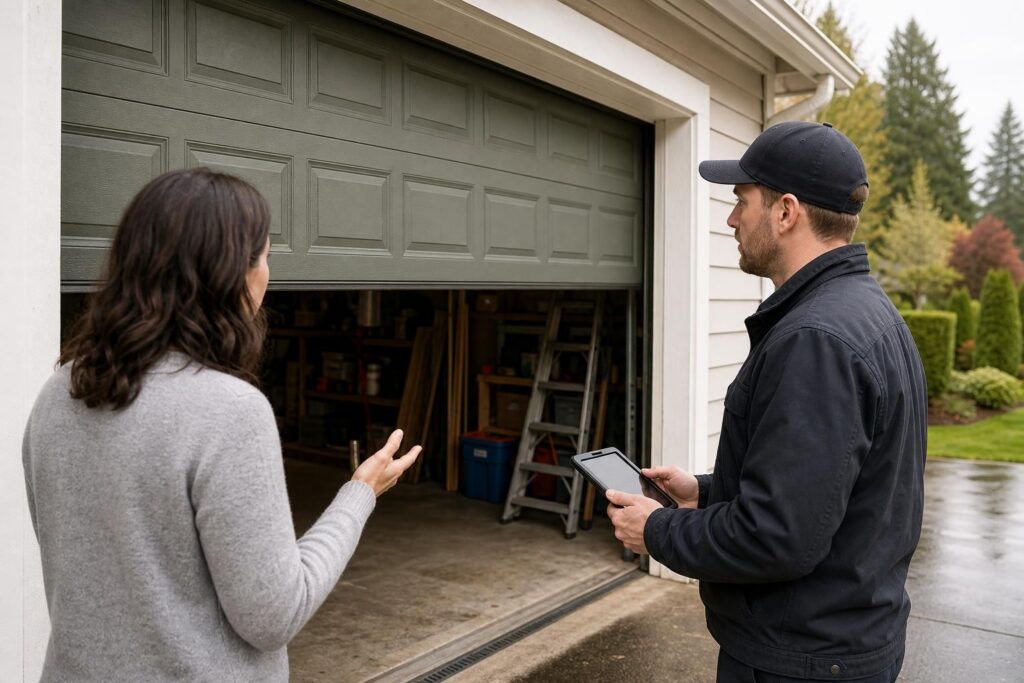
The best information to give a technician is the door position, what happened right before it stopped, what sounds you heard, and whether anything looks crooked, loose, or damaged. Plain descriptions are often more useful than technical terms.
Start with where the door is now. Is it stuck halfway, stuck open, or nearly closed? If you searched for garage door stuck open Renton because the door won’t come down, say whether it is level or tilted. Also mention whether a vehicle is trapped inside.
Share what the opener did. Did it hum? Did the light flash? Did the motor run while the door stayed still? Did the door move a few inches and stop? If the opener hums but the door won’t move, that detail can point toward opener strain, balance trouble, or hardware resistance.
Also mention if any of these happened:
- A vehicle bumped the door.
- A storage bin fell near the track.
- Wind or debris hit the opening.
- The door has been noisy for days or weeks.
- The door stops halfway at the same spot every time.
- A cable looks loose, frayed, or uneven.
- A spring appears separated or broken.
Photos can help if you take them from a safe distance. Don’t touch parts to get a better angle. For Renton homeowners dealing with a stuck or unsafe door, Dan’s Garage Door Services can use these details to prepare for garage door spring repair risks and other high-tension issues before arriving.
Request Same-Day Repair in Renton
Request same-day repair in Renton when the door is stuck open, blocking your car, sitting crooked, or refusing to move safely after basic checks. A stuck garage door can affect home access, security, and daily plans.
When you call Dan’s Garage Door Services, explain that the door stops halfway and describe what you observed. You don’t need to diagnose it. A service visit should check the full system: opener behavior, spring balance, cables, rollers, tracks, sensors, and door alignment.
Mention whether you need the door secured before night, whether a car is trapped, or whether the door is open to the street. Those details help prioritize the situation and prepare for the likely repair path.
A technician may find a simple obstruction or sensor issue. Or the opener may have stopped because the door is too heavy, crooked, or jammed. Either way, the repair should address the reason the door stopped, not just force it to move once.
Dan’s Garage Door Services handles garage door repair Renton calls for stuck doors, opener trouble, and unsafe hardware problems. Ask about same-day help if your door is stuck halfway, stuck open, or no longer closes reliably.
Conclusion
A garage door stuck halfway in Renton is a signal to stop, observe, and avoid forcing the system. Sensor or opener issues may be simple, but crooked movement, heavy lifting, loose cables, damaged tracks, or loud strain can point to a serious hardware problem.
Your safest next step is to clear obvious obstructions, check sensor lights, note what the opener does, and stay away from tension parts. If the door still stops halfway or looks unsafe, contact Dan’s Garage Door Services for same-day garage door help in Renton.